Telemarketing is one of the most important solutions companies use to increase sales. It relies on a professional call center to get the job done. The more professional the call center and the more efficient the staff, the higher the conversion rate and the more positive the results for the company.
That’s why we needed to learn more about telemarketing and understand its benefits as well as the challenges we face in using it. That’s the topic of today’s article, so let’s get started.
The Concept of Telemarketing
The term “telemarketing” first appeared in the 1970s, with the emergence of low-cost long-distance telecommunications services and toll-free numbers. It refers to the process of communicating with target customers and attempting to persuade them to purchase the products or services being offered. The telemarketing process typically begins with a call to the customer to gauge their interest in the service or product, followed by subsequent communications until the customer is convinced to make a purchase.
Telemarketing is conducted through a call center staffed by professionals skilled in closing sales. It relies on The call center through which you communicate with target customers relies on data that helps identify the customers most likely to make a purchase.
Telemarketing is not limited to any specific sector; rather, it can be used by for-profit organizations such as restaurants and nonprofit organizations such as charities. It is also used for surveys, fundraising, market research, and other organizational purposes.
Types of Telemarketing
Telemarketing campaigns take many forms, and below we’ll explore these types in some detail. Let’s get started.
Outbound Calls
In this case, the telemarketing company contacts potential customers to convince them of the company’s services and encourage them to purchase them. A sales-focused call center can also contact existing customers to inform them of new offers your company is providing and encourage them to take advantage of them as soon as possible.
Inbound Calls
These calls come from customers who are familiar with the company’s services and new offers. They result from the customer seeing one of the company’s ads on social media or even on TV, and in response to the ad, the customer contacted your company. The sales representative’s role in this telemarketing process is to capitalize on the customer’s enthusiasm for the product or service and convince them to accept the best possible deal.
Lead Generation
What we mean by this type of telemarketing is the use of phone calls with customers to collect information and data about them—such as their interests, demographic information, and purchasing behaviors—in order to build a database useful for marketing and sales. This process is repeated to ensure that the company continuously updates its databases.
Opinion Polls
Social research centers, academics, political campaigns, and media organizations can conduct numerous telephone marketing campaigns to gauge the opinions of their target audience on a specific issue. For example, if there is a presidential election with two candidates, a media organization could launch a telephone marketing campaign every three months to determine which candidate has a better chance of winning the election.
Benefits of Telemarketing for Your Company
Now that we’ve explored the nature and types of telemarketing, it’s time to discover its key advantages that will motivate you to hire a team from an outsourced call center or build an in-house team at your company to carry out this task.
Reducing the Marketing Budget
A telemarketing service doesn’t require a large budget for your company. If you’re using an in-house team, a cloud-based call center will suffice—eliminating the need for servers, hardware, maintenance, and office space for employees. If, on the other hand, you plan to rely on an external team, you can contract with a third-party call center that excels in sales and is located in a country with lower operating costs, such as Egypt or India. This will allow you to conduct telemarketing at the lowest possible cost without compromising quality.
Increasing Your Company's Sales
Telemarketing is an effective way to generate sales. Through phone calls, sales representatives or even customer service representatives Automated Response: Helps close deals immediately by leveraging persuasion and explanation skills. This type of marketing yields immediate results in terms of increased sales, provided it is executed correctly; this requires thorough training, in-depth knowledge of products and services, and an understanding of customer needs.
Interactivity in Communication
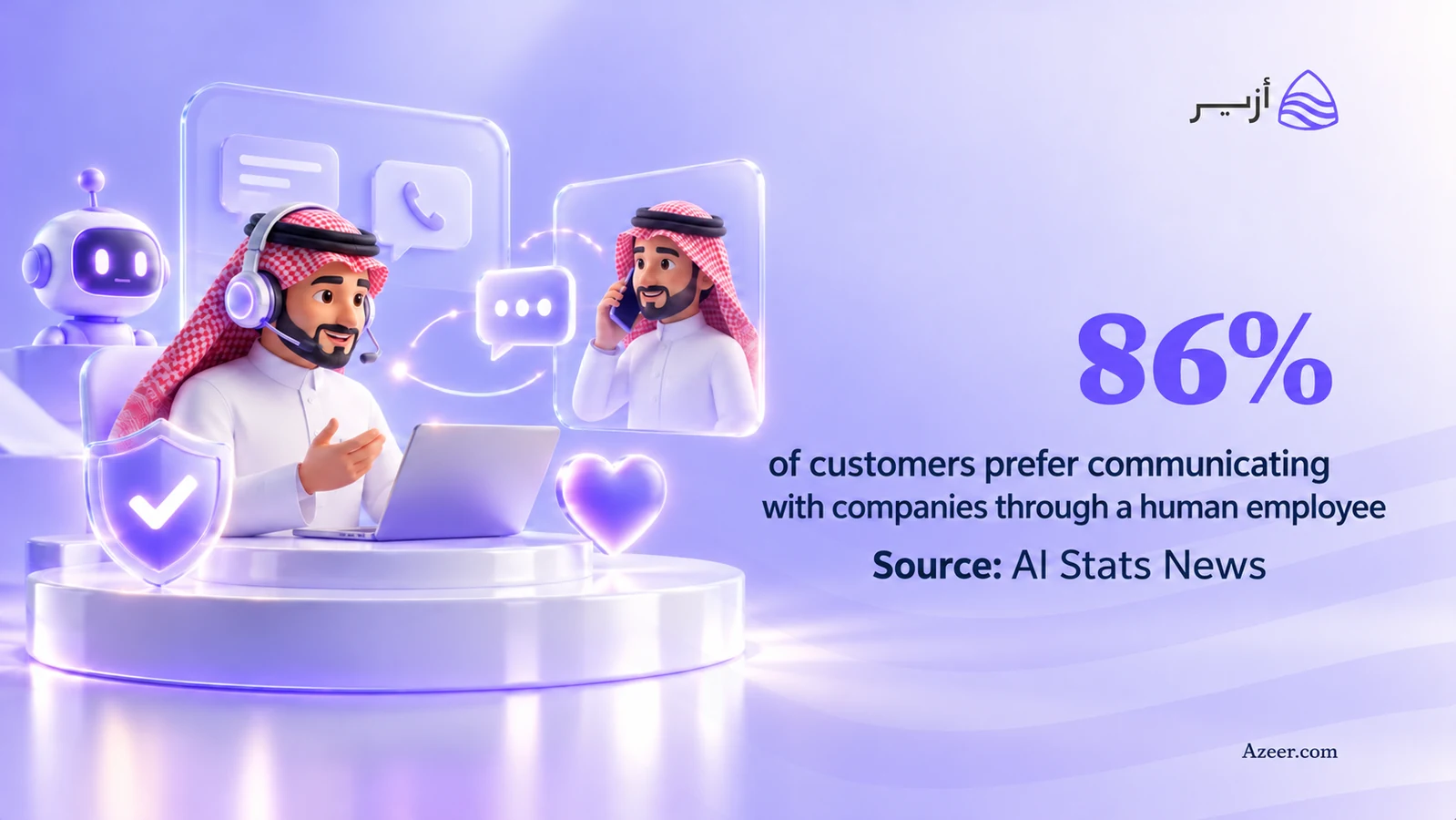
Telemarketing allows for more interactive conversations with customers, enabling the creation of a strong, trusting relationship in a short amount of time—depending on the skill of your sales representative. This is confirmed by statistics: a study conducted by AI Stats News indicates that 86% of customers prefer to deal with human representatives rather than bots.
So use these calls to better understand the potential customer’s personality and needs, which will help you create the right conditions to close the sale.
Updating Databases
: Telemarketing helps you ensure that your databases are constantly updated, understand how your customers rate the services they received over a specific period, and identify your customers’ demographics and their interests. For example, if you run an online store and have dealt with a customer named “Talal” in Jeddah, and then you contact him six months later and find that he has moved to “Riyadh.” You can use this information—along with their behaviors and interests—to refine the targeting of your marketing campaigns.
Self-Service and Time Savings
: Call centers engaged in telemarketing can use automated dialing to speed up the process of contacting customers. This is done by uploading a list of target customer numbers to your call center system and then calling them all at once. When a customer answers, the call is transferred directly to the appropriate sales representative, while unanswered calls are filtered out—without requiring you to manually dial each number individually.
Thus, automated dialing helps you save time, increase productivity, and even boost sales rates. There is another benefit to it, which we’ll explore in the next feature.
Call Evaluation
One of the key stages in the marketing funnel: Reach out to customers who have purchased one of your products or started using your services to find out how they rate their experience with you, assess the performance of the sales representative they interacted with, and determine whether they encountered any issues with shipping or other matters. Here, you can leverage automated calling in your business to enhance your telemarketing efforts.
Once your customer has received the product you sold over the phone, the call center system is set up to trigger an automated call—either through an automated response or by transferring the call to a representative—for the purpose of evaluation. This call ensures that any issues are resolved quickly and increases customer satisfaction with your services.
Scheduling Meetings
Sometimes customers prefer to schedule a meeting after a telemarketing call. In such cases, it’s easy for you to arrange and schedule this meeting during the call with the customer—whether in person, if the customer is in the same city as the employee, or remotely using Zoom, Google Meet, or other remote meeting tools.
Telemarketing Challenges
Companies face certain challenges when relying on various types of telemarketing, and in the next section of today’s topic, we’ll explore those challenges.
Compliance with Regulations and Laws
Telemarketing is subject to strict laws in many countries, such as requirements to obtain prior consent from customers before contacting them to offer services. Any violation of these laws can result in significant fines or legal action against the company, posing a real risk to businesses that conduct telemarketing campaigns by illegally purchasing customer numbers and then contacting them at random.
Call Termination Rate
If a high percentage of customers hang up immediately without hearing what your sales representative has to offer, this will result in a waste of time and resources and undermine the effectiveness of the marketing campaign, especially when sales representatives are unable to overcome the initial barriers to the call.
Marketing Team Management
Telemarketing is considered a time- and resource-intensive approach. It requires extensive training of employees in communication and persuasion skills, meticulous management of prospect lists and continuous follow-up, as well as ongoing supervision of performance quality and monitoring of results.
You can overcome this challenge by contracting with a professional outsourced call center that can assist you with telemarketing if you are unable to meet the operational requirements at the management level.
Low Response Rate
Some customers do not answer calls from unknown numbers, ignore numbers associated with companies and services, and some use tools to filter incoming calls. These factors reduce response rates to telemarketing campaigns, thereby lowering the conversion rate you achieve.
Conclusion
At Azeer, we offer a cloud-based call center system that ensures you can overcome all operational challenges to launch a professional call center that enables you to perform various tasks, whether in customer service, sales, and, of course, telemarketing for your company. Learn more about its features now, and book your free consultation with our team.
Frequently Asked Questions
Can telemarketing be integrated with other channels?
Absolutely—the integration of these channels is what’s known as Omnichannel Marketing. You can start the conversation over the phone and then follow up with the customer via WhatsApp to confirm an order or send offers, or via email to share a catalog or promotional offer, which increases the chances of closing a sale and improves the customer experience.
How are telemarketing staff trained to close sales successfully?
Training typically begins by thoroughly instructing employees on the details of the product or service, followed by the use of flexible call scripts that allow for natural interaction with the customer. Emphasis is also placed on active listening skills, handling objections, and using the right tone of voice. In addition, some companies rely on recording and analyzing calls to continuously improve employee performance.
Can the telemarketing process be fully automated?
Certain stages, such as automated dialing, call scheduling, and sending voice or text messages, can be automated,
but the most important part—persuasion and building trust—still relies on the human element. Here, the combination of automation and human interactions is what yields the best results.